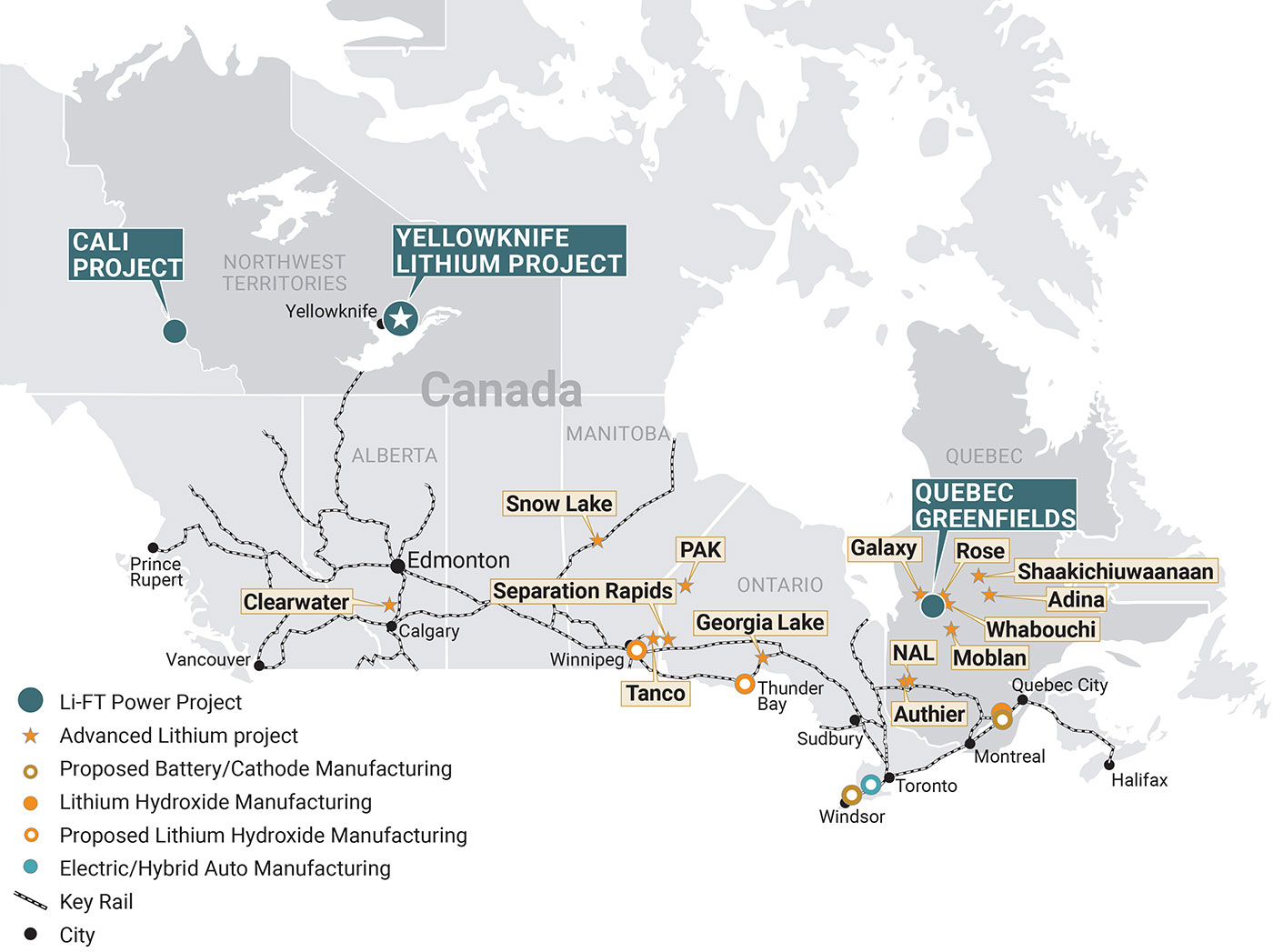

One of the most exciting exploration and development portfolios of hard rock lithium projects in the Americas:
World-class hard-rock lithium potential
- Yellowknife Lithium Project (NWT): A portfolio of 13 spodumene pegmatites with a 50.4 Mt at 1.00% Li₂O inferred resource — one of the largest spodumene projects in the Americas — with excellent road and rail infrastructure and strong metallurgical results (79% recoveries, 5.83% Li₂O concentrate grade)
- Adina-Galinée Project (Québec): A top-tier, near-surface hard rock spodumene deposit with 78 Mt at 1.15% Li₂O (Indicated + Inferred), a completed PEA, and significant upside from combining the Adina and Galinée land packages. Located 60 km from the Renard diamond mine, which offers a low-CAPEX processing pathway using existing infrastructure
- James Bay Greenfields (Québec): Ground around world-class deposits including Whabouchi, with a 25 km spodumene-in-till anomaly at the Pontax Project
- Cali Property (NWT/Yukon border): Numerous high-grade spodumene pegmatite swarms across a 1.5 km × 1 km area, with surface rock samples up to 2.43% Li₂O preparing for initial drilling
Active 2026 work programs across the portfolio
- Resource drilling underway at the Yellowknife Lithium Project (Feb–Apr 2026, with a second phase Jul–Oct 2026), targeting a resource update and Preliminary Economic Assessment in 2027.
- Combined Adina-Galinée mineral resource estimate and trade-off studies on the combined deposit and Renard facility underway (Jan–Jun 2026), followed by a 40,000 m drill campaign (Jun–Oct 2026) and a PFS & resource update from October 2026 onwards
- Second year of environmental baseline studies at the Yellowknife Lithium Project (Apr–Nov 2026)
- Scoping study for Lithium Carbonate Converter in Alberta
Well-financed with a strong capital markets profile
- C$35M cash & 86.7M shares fully diluted (pro forma); dual-listed on TSXV and ASX (subject to approval)
Environmental Baseline Data Collection
- Aquatic Studies: Monitoring of surface water quantity and quality, aquatic life (plankton, benthos, fish), and hydrogeology to establish current water conditions
- Terrestrial Surveys: Assessment of soils, vegetation, wildlife, permafrost, and host rock geochemistry to understand land-based ecological systems
- Atmospheric Monitoring: Collection of air quality data, as well as light, noise, and vibration levels to inform environmental impact assessments
- Human Environment: Evaluation of heritage resources, land use, socio-economic conditions, and community health to guide responsible development